
340B-Driven Health Care Consolidation Came to Iowa
October 21, 2026
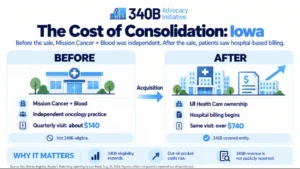
In October 2024, the Iowa Board of Regents approved the University of Iowa Health Care (UIHC) system’s purchase of Mission Cancer + Blood, the Des Moines area’s largest independent oncology practice.
The university president called it a “special opportunity,” and its medical affairs vice president said Iowans didn’t have enough access to cancer care, especially in rural parts of the state. Executives said the deal would extend the system’s reach throughout Iowa, where the cancer rate is the second highest in the country.
UIHC has been a 340B covered entity since 1999. Mission, as an independent practice, was never eligible for the federal program. And then when the sale closed, roughly 20 oncology clinics moved inside the covered entity. This is an example of the worrisome trend: 340B creates financial incentives for health care consolidation.
Patients Take Note
In June 2025, UIHC switched Mission’s clinics to hospital billing. One patient, 67 and in remission from prostate cancer, went from paying around $140 for a quarterly visit to over $740. Same blood test, injection, and appointment.
The higher patient bill comes from hospital-based billing and the resulting facility fee, not from 340B itself. UIHC acknowledges that hospital-based billing separates professional and hospital charges and can lead to higher out-of-pocket costs for patients.
However, the 340B incentive remains significant though less visible: once an off-site clinic qualifies and is registered under a 340B hospital, eligible outpatient drugs can be purchased through the program at discounted prices. For high-cost oncology drugs, that can create new revenue for the covered entity.
Hospital System Justifications
These increases in patient costs concerned Governor Kim Reynolds, who asked UIHC to stop charging the higher fees. UIHC’s CEO wrote back that federal rules simply require them. Federal rules do govern how a hospital bills once a clinic becomes part of it. However, nothing in statute required the business decisions that led to buying Mission, converting the clinics, or charging facility fees for patient visits that are more than an hour from the main location.
As is the case with 340B broadly, there is no public documentation stating how much 340B revenue UIHC actually generates. Hospital covered entities aren’t required to report it; patients, policymakers, and the public aren’t able to follow the claims or understand the impact of the care that the 340B discounts are meant to strengthen.
Iowa Isn’t the Exception
Congress created 340B so providers serving patients with the least ability to pay could stretch limited financial resources. That purpose still holds. What has changed is the scale of the program and the range of transactions it now shapes, including acquisitions like this one in Iowa.
Iowa is a useful case less because it is unusual than because it is thoroughly documented. Many acquisitions may produce no comparable record or series of reporting, so the same questions about federal program impact and underserved populations go unasked, undocumented, and unanswered.
A reformed 340B program would make those questions answerable, with entities transparently reporting what 340B generates and how that money is used to support the patients Congress intended when establishing the discount. With bipartisan interest in reform growing, the savings can be aimed directly at underserved patients, and the incentives driving consolidation can be cleaned up. A federal discount meant to stretch limited dollars should not be what determines who owns a cancer practice.