
How 340B Incentivizes Health Care Consolidation
September 21, 2026
A patient walks into their oncologist’s office for a routine follow-up: same doctor, same waiting room, same blood draw she’s had for years. Then the bill arrives: four times what she paid last time for the same visit.
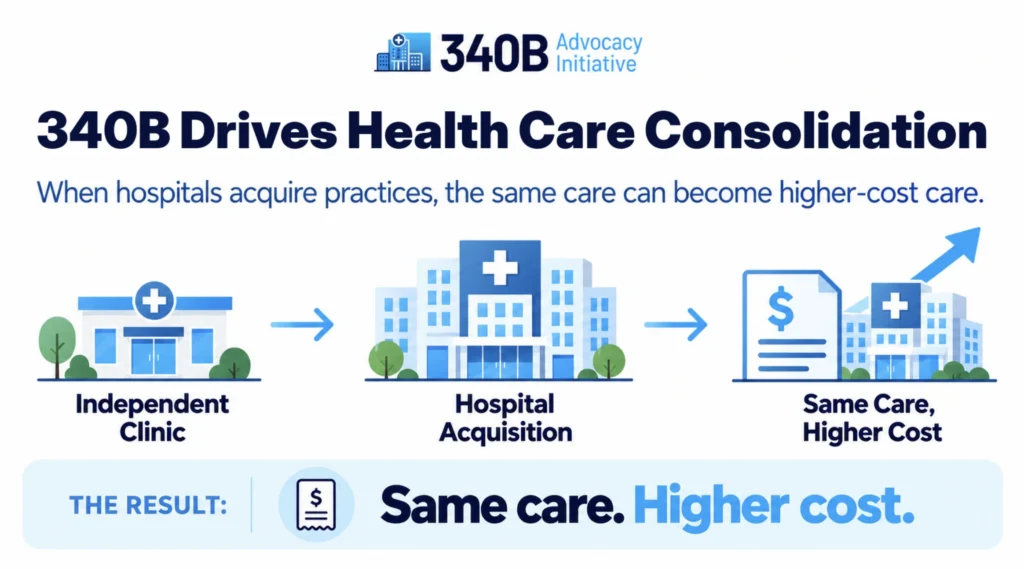
Nothing about her care changed. What changed is who owns the practice. When a hospital system buys an independent clinic, the same appointment can get billed at hospital rates instead of physician-office rates, including adding a facility fee tied to ownership, not treatment. Unfortunately, this is a national pattern. Hospital acquisitions of physician practices climbed more than 70 percent between 2008 and 2016, and prices for identical services jumped 15 percent once a practice joined a hospital system, according to research led by Yale health economist Zack Cooper.
The 340B Math
One reason for the increase in hospital acquisition of independent practices is the federal 340B drug discount program available to qualifying hospitals. Created in 1992 to help safety-net providers stretch thin budgets, 340B lets certain hospitals buy covered drugs at steep discounts, administer them, and bill insurers at the hospital’s own rate, pocketing the difference. An independent practice generally can’t get that discount on its own. But the moment a hospital acquires that practice, the same drugs become 340B-eligible. Nothing about the clinic changed. Only its owner did.
That math makes an independent practice worth more to a hospital than it is to itself. The effect is strongest in oncology, where the drugs are the most expensive and the discount can be the largest in dollar value. Cancer drugs alone make up 41 percent of all 340B purchases nationally, nearly three times any other category, according to the Congressional Budget Office.
The Community Oncology Alliance, which represents independent oncology practices, points to the same pattern: growing evidence that 340B’s structure has driven hospital acquisition of physician practices, migrated care to higher-cost outpatient departments, and increased costs for patients, employers, taxpayers, and Medicare.
Why Acquisitions Should Worry Policymakers
Hospitals like to point to federal billing rules to explain the higher charges. Those rules are real, but converting an acquired practice into a hospital outpatient department is a choice a system makes, not something federal law requires.
The patient absorbs the facility fee directly, increasing their out-of-pocket cost, at a time when more than a quarter of Americans already skip care because of cost, according to the Federal Reserve. And patients have fewer places to go, as independent, lower-cost options get absorbed into bigger systems.
And the costs don’t stop with the patient; it hits the entire healthcare system. The 340B program itself keeps getting more expensive: discounted drug purchases hit a record $100 billion in 2025, up nearly 23 percent from 2024.
What doesn’t grow alongside the rate of consolidation and discount drug purchases is the quality of care. The research from Yale found these acquisitions raise prices well beyond what any efficiency gain could explain, without improving the quality of care.
Many expect 340B savings to be used to provide care to uninsured patients. Unfortunately, there’s little way to check a hospital’s own account of where the savings go. Unlike safety-net clinics, hospitals aren’t required to report how much 340B revenue they collect or spend. And an analysis of nearly 4,000 hospitals found 340B hospitals provide less charity care, on average, than hospitals outside the program.
What Reform Means
Congress hasn’t touched the 340B statute since 2010, when the Affordable Care Act expanded which hospitals could qualify for the program, despite growing bipartisan interest in doing something about it. This trend toward consolidation is more evidence that reform can’t wait: the incentive doesn’t expire after one deal. It applies fresh to every acquisition a hospital considers, which is why consolidation keeps building instead of leveling off. Reform doesn’t mean dismantling 340B, but it does require addressing the incentives that make selling an independent practice more profitable than treating the patients that are in it.